Planning note · design strategy
How to build a t‑shirt bar design menu guests actually love
The menu board decides more about your event than the press does. After watching thousands of guests stand in front of that board, here is the formula we push every client toward.
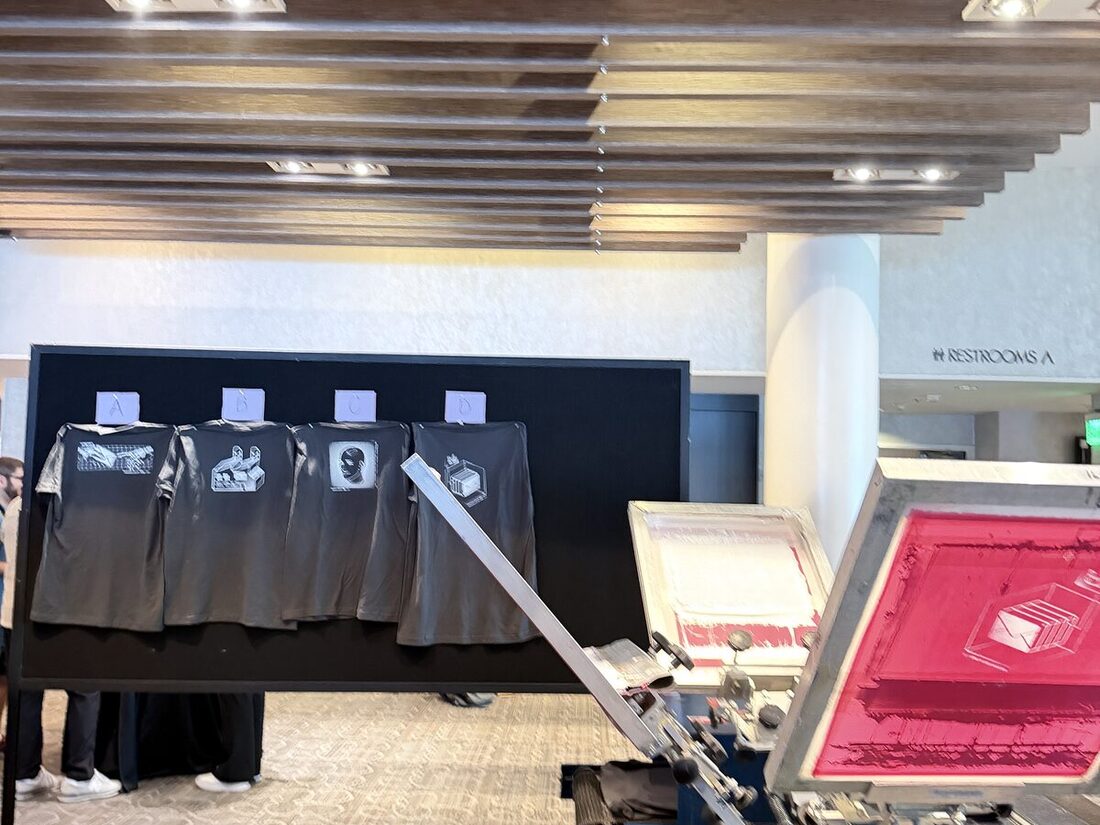
Six slots. Not twelve. Definitely not twenty.
Choice feels generous until it stalls a line. Guests facing six options decide in seconds; guests facing fifteen ask the person behind them what they are getting. Our throughput data is blunt about this: menus past twelve options slow the board more than any press ever slows the platen. Six is the sweet spot; eight is the ceiling for crowds with time to browse.
The slot formula
- Two anchor designs — the official marks: event logo, brand lockup, school spirit
- Two audience designs — made for subgroups: a program, a team, a city, an era
- One wildcard — the joke, the meme, the design legal almost vetoed
- One flex slot — seasonal, co-brand, or a second wildcard if the first tests well
The wildcard needs defending in every planning call, so here is the defense: it outsells the primary logo at roughly two to one, almost every event. People wear jokes. They tolerate logos.
Design for the garment, not the deck
Art that looks great on a slide dies on a shirt: hairline strokes vanish, tiny type fills in, and edge-to-edge layouts fight seams. Big shapes, confident color, one idea per shirt. Full-color DTF handles gradients and photo detail beautifully — the constraint is legibility at six feet, because that is where the next guest in line is standing.
Proof on the actual blank
Colors shift on fabric, and heather blanks mute everything a step. We press physical proofs of the full menu on the exact blanks for the event and photograph them for sign-off — two weeks out, so there is a revision window. The menu board itself then displays those proofs, which is why guests trust what they order: they are looking at the finished product, not a rendering.
Letter the board like a real bar menu
Small thing, outsized payoff: give every slot a letter, A through F, printed big next to the proof. Orders compress to two syllables — “C, in a large” — which keeps the press fed and strips every ambiguity out of the handoff. Placement on the board matters too. Eye level is prime real estate; put the wildcard there, because it converts browsers into buyers, and let the anchor logo hold the top corner where the people who came for the logo will find it anyway. Bottom row is for the flex slot — the design you plan to swap. Guests photograph a lettered board more often, too, and every photo of the menu circulating a market is free line-building for the next hour.
Multiply the menu with the rack, not more art
Six designs on three blank colors is an eighteen-combination menu that still decides like a six-option menu. That is the cheat code. Guests experience the richness (“the sunset one on the sand tee!”) without the decision paralysis of eighteen separate designs on the board. The discipline sits in the pairing: proof every design on every rack color, and quietly retire any combination that muddies — a low-contrast design on heather is the usual casualty. Two designs tuned for dark blanks, two for light, two that work everywhere is the split we spec most. The rack does the merchandising; the board stays fast.
What a tuned menu did at a tour stop
A recent brand tour date shows the formula working. Six slots: two brand lockups, a city-name design for the stop, a decade-throwback audience design, one wildcard (the brand’s mascot doing something legal barely approved), and a flex slot rotating per city. Across a five-hour stop the wildcard took 34% of all presses, the city design 27%, and the two official lockups combined for under 25% — exactly the two-to-one pattern. The client’s takeaway wasn’t to cut the logo; it was that the logo belongs on the sleeve of the wildcard, which is what shipped at the next stop. Menus are not fixed documents. They are hypotheses with a press attached.
The physical board earns its keep
Screens glare in daylight and die at outdoor breakers; a printed board never does. Ours run 24×36 minimum — readable from the back of a twenty-person line — with the pressed proofs pinned beside each letter and prices (if any) in type as big as the art. One more habit worth stealing: a small “pressing now” clip that moves down the board with each order gives waiting guests something to track, and a tracked wait always feels shorter than an ambiguous one. Cheap trick, real effect.
Let the menu learn
Every event ends with a count of what pressed, by design. Recurring programs should treat that as menu research: keep the winners, evolve the middle, replace the loser. The market case study shows what three weeks of that iteration did to repeat traffic. Ready to draft yours? Start the quote and bring your roughest ideas — art direction is included.